Microneedling OEM & Private Label
Solid vs. Hollow Microneedles: What Should Beauty Brands Know?
Learn the differences between solid and hollow microneedles, how serum delivery works, and what beauty brands should check before choosing an OEM device.
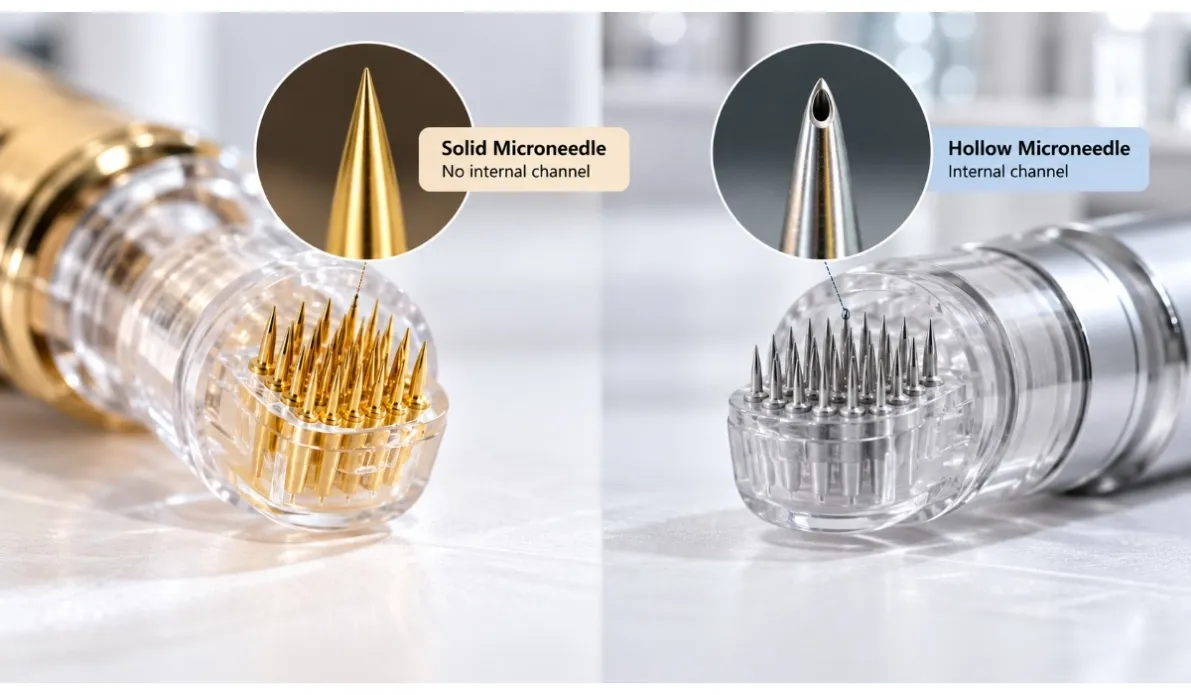
When developing a private label microneedling product, beauty brands often focus on needle length, serum capacity, packaging design, and price.
However, one important technical detail is sometimes overlooked:
Are the microneedles solid or hollow?
Recently, a beauty brand contacted us while evaluating a 0.25 mm micro-infusion device.
The buyer asked whether the needles were hollow and whether the serum flowed directly through the needles.
This question highlights an important distinction in microneedling device design.
Solid and hollow microneedles may look similar from the outside, but their internal structures and liquid delivery mechanisms are different.
Understanding these differences can help brands choose a suitable device before investing in samples, packaging, and commercial production.
1. What Are Solid Microneedles?
Solid microneedles are tiny needles without an internal liquid channel.
Their primary mechanical function is to create microchannels in the skin.
In a micro-infusion device that combines solid needles with a serum reservoir, the liquid does not travel through the needles themselves.
Instead, serum may be released through specially designed openings or spaces around the needle area.
For example, our E24 micro-infusion device uses 24 solid, 24K gold-plated stainless steel needles.
The device combines a needle head with a serum dispensing structure.
The important distinction is that the needles and the serum delivery openings are separate components of the delivery mechanism.
This is why a solid-needle micro-infusion device can dispense liquid even though its needles are not hollow.
However, the presence of a dispensing mechanism does not automatically establish how much serum enters the skin.
That depends on the device design, application conditions, formulation, and supporting test evidence.
2. What Are Hollow Microneedles?
Hollow microneedles contain an internal channel.
Unlike solid needles, the hollow structure provides a potential pathway for liquid to pass through the needle itself.
This design is used in certain specialized microneedling and fluid-delivery applications.
For example, our ER80 adjustable microneedling device is available with different needle configurations:
- Silver needle version: Hollow needles
- Gold needle version: Solid needles
Although these versions belong to the same device family, their needle structures are not interchangeable descriptions.
Buyers should confirm the exact needle configuration before requesting samples or preparing product specifications.
It is also important to understand that a hollow needle does not automatically guarantee a particular delivery volume, penetration depth, or clinical result.
These characteristics require appropriate testing.
3. Solid vs. Hollow Microneedles: Key Differences
Feature | Solid Microneedles | Hollow Microneedles |
|---|---|---|
Needle structure | No internal channel | Internal channel |
Liquid pathway | Separate openings, if included in the device | Through the needle lumen |
Primary design principle | Mechanical microchannel formation | Microchannel formation with potential fluid delivery |
Example from BEGOSKIN | E24, ER80 gold needle version | ER80 silver needle version |
Important evaluation | Needle specifications and external dispensing design | Needle specifications, lumen design, flow performance |
Regulatory considerations | Depend on intended use and claims | Depend on intended use, delivery mechanism and claims |
Neither design should automatically be described as safer, more effective, or more suitable for home use.
Those conclusions require evidence for the specific product and its intended application.
4. Does Hollow Needle Design Automatically Mean Better Serum Absorption?
Not necessarily.
Some buyers assume that hollow microneedles must deliver skincare ingredients more effectively because liquid can pass through the needle.
However, device structure alone cannot establish superior absorption or treatment results.
Several factors may influence performance:
- Needle dimensions and geometry
- Liquid flow characteristics
- Formulation properties
- Application conditions
- Skin characteristics
- Device design and testing
For private label brands, the correct question is not simply:
"Which needle delivers more serum?"
A more useful question is:
"Which device has the appropriate design and supporting evidence for our intended product application?"
This distinction helps brands avoid making product claims that cannot be supported by technical documentation.
5. Are Hollow Microneedles Considered Medical Devices?
This is an important question for brands planning to sell in different countries.
A hollow needle structure may raise additional regulatory considerations, particularly when the product is intended to deliver substances through the skin.
However, regulatory classification cannot be determined from needle structure or length alone.
Authorities may consider:
- Intended purpose
- Product design
- Method of substance delivery
- Depth and nature of skin penetration
- Product claims
- Target users
- Applicable national regulations
For example, a 0.25 mm needle length does not automatically establish that a product qualifies as a cosmetic device.
Similarly, not every hollow-needle product can be assigned the same medical device classification.
Brands should confirm the applicable regulatory requirements in their target markets before commercializing either device type.
The intended use and technical documentation should be reviewed together.
6. What Should Buyers Confirm Before Choosing a Device?
When comparing solid and hollow microneedling devices, we recommend confirming five technical details with the supplier.
1. Needle structure
Are the needles solid or hollow?
Request confirmation for the exact model and needle configuration.
2. Needle specifications
Confirm the needle material, needle count, length, and relevant dimensions.
3. Liquid delivery mechanism
Does the device release liquid around the needles or through an internal needle channel?
Ask for a technical explanation or demonstration.
4. Intended application
Will the device be positioned for cosmetic home care, professional aesthetic use, or another application?
The intended use should be defined before making regulatory claims.
5. Supporting documentation
Ask which technical specifications, sterilization records, material information, and relevant test reports are available for the selected configuration.
A product photograph alone is not enough to verify these details.
7. Why Sample Selection Matters for Private Label Brands
Two devices may have similar external appearances but different internal structures.
This can create confusion when buyers compare quotations from multiple suppliers.
For example, a brand may request an adjustable microneedling device without specifying whether it requires solid or hollow needles.
The supplier may then quote a configuration that does not match the buyer's intended application.
To avoid this problem, brands should confirm the needle structure before proceeding with packaging artwork or commercial orders.
At BEGOSKIN, we recommend reviewing the intended use and device specifications first.
Once the appropriate configuration has been identified, buyers can evaluate physical samples and determine whether the device meets their product-development requirements.
For additional guidance, read our article:
This explains why the intended purpose of each component should be clarified before sampling and compliance review.
Conclusion: Choose the Needle Structure Before Choosing the Packaging
Solid and hollow microneedles are not simply two different needle finishes.
They represent different structural designs that can affect liquid delivery, product evaluation, and regulatory considerations.
For beauty brands developing private label microneedling products, understanding the needle structure is an important step in supplier selection.
Before comparing prices or finalizing packaging, confirm whether the proposed device uses solid or hollow needles and whether its specifications support the intended application.
Looking for a Private Label Microneedling Device?
BEGOSKIN supports OEM/ODM microneedling device projects, including solid-needle and selected hollow-needle configurations.
Our team can help you review available device specifications and arrange samples for evaluation.
Are you looking for a solid-needle or hollow-needle device for your brand?
Contact BEGOSKIN with your target market and intended application so we can discuss suitable options.