Wholesale & Sourcing Guides
Should Your Brand Choose a Standard or Pump Micro-Infusion Device?
Compare standard and pump micro-infusion devices from a buyer’s perspective. Learn which option better fits your brand positioning, budget and product strategy.
When buyers start developing a private label micro-infusion product, one of the first equipment decisions is often:
Should we choose a standard micro-infusion device or a pump-style device?
At first glance, the difference may seem simple.
One option is usually more basic and cost-effective, while the other has a more obvious mechanical structure and a stronger premium feel.
But the right choice should not be based on price alone.
It should depend on your brand positioning, target customer, expected user experience, and product strategy.
1. A Common Buyer Situation
Recently, a UK buyer evaluating a scalp micro-infusion project asked whether a standard device would be enough, or whether a pump-style device would be a better choice.
This is a common question.
Both device types can be suitable for private label projects, but they are designed for different product positioning.
The key question is not:
“Which device is better?”
The better question is:
“Which device is more suitable for the product I want to launch?”
2. When Does a Standard Device Make Sense?
A standard micro-infusion device can be a practical option for brands that want to control initial project cost.
It may be suitable when:
- The brand is testing the category for the first time
- The target retail price is relatively accessible
- The product concept is simple
- The buyer wants to focus on basic device function
- The first launch needs to stay commercially efficient
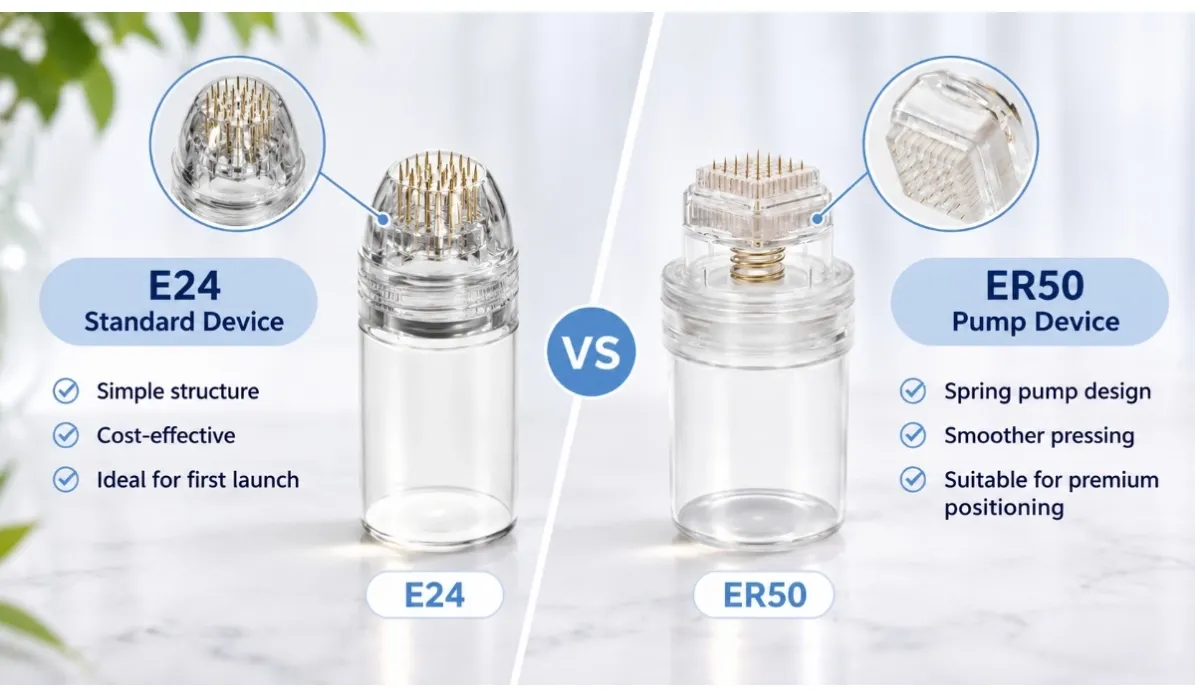
For example, a standard device such as E24 can be a suitable starting point for brands that want to evaluate the market before investing in a more premium configuration.
The main advantage is simplicity.
For many new projects, that is not a weakness.
It can actually make the first product easier to position and easier to evaluate.
3. When Does a Pump Device Make Sense?
A pump-style device may be more suitable when the brand wants the applicator itself to feel more differentiated.
For example, BEGOSKIN's ER24 and ER50 use a spring-based pump structure.
This creates a different pressing experience compared with a standard device.
A pump-style product may make more sense when:
- The brand wants a more premium positioning
- The device is an important part of the product story
- The buyer wants a more noticeable mechanical experience
- The retail price can support a higher-specification device
- The brand is comparing itself with more premium competitors
In these situations, the device is not simply a tool inside the kit.
It becomes part of the perceived product value.
4. Why Price Alone Should Not Decide
Buyers often compare device quotations first.
This is understandable, but it can lead to the wrong decision.
A lower-cost device may fit one brand perfectly, while a more expensive pump device may make more sense for another.
The important question is how the device supports the final retail product.
For example:
A brand selling a simple starter kit at an entry-level price may not need a more complex pump mechanism.
A brand positioning its product as a premium at-home beauty system may benefit from a device with a more distinctive operating structure.
The price difference should therefore be evaluated together with:
- Product positioning
- Target retail price
- Customer expectations
- Brand image
- User experience
5. Does a Pump Device Automatically Mean Better Results?
No.
A pump mechanism should not automatically be described as producing better cosmetic results.
The mechanical structure can change the user experience and device operation, but product performance depends on more than the pump itself.
Factors may include:
- Needle specifications
- Application method
- Device design
- Product consistency
- User handling
- Supporting test evidence
For buyers, the value of the pump mechanism is mainly in product design and user experience unless specific performance claims are supported by evidence.
This distinction is important when preparing marketing materials.
6. How Should a Buyer Compare the Two?
A simple way to evaluate both options is to ask three questions.
Question 1: What is my target retail position?
If your goal is an accessible first product, a standard device may be sufficient.
If you are building a more premium product concept, a pump-style device may be worth evaluating.
Question 2: How important is the device experience?
If the device is only one component of the kit, the standard option may work well.
If the applicator itself is a major selling point, the pump structure may offer stronger differentiation.
Question 3: Have I tested both devices physically?
This is important.
Photos and specifications can explain the structure, but they cannot fully show the pressing feel, handling, assembly, and overall product experience.
For this reason, physical sample comparison is often the most useful step before final selection.
7. A Simple Decision Rule
For buyers who are still unsure, a simple approach is:
Choose a standard device first if:
- You are testing the market
- You want to control initial product cost
- You prefer a simple product concept
Evaluate a pump device if:
- You want stronger product differentiation
- You are targeting a more premium positioning
- The mechanical user experience is important to your brand
Neither option is automatically better.
The best device is the one that supports your product strategy.
Conclusion
Choosing between a standard and pump micro-infusion device is not only a technical decision.
It is also a branding and commercial decision.
A standard device can be a practical choice for a first launch.
A pump-style device may be more suitable when the applicator itself needs to support a premium product story.
Instead of asking which device is better, buyers should ask:
Which device best matches my target customer and retail positioning?
Need Help Comparing Device Options?
We can help buyers compare standard and pump-style device options and arrange samples for evaluation.
Is your priority lower launch cost or a more premium device experience?
Share your product positioning with us, and we can recommend suitable options.